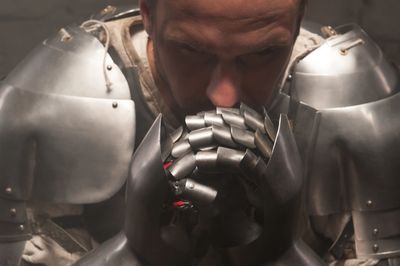
Weapons: From Survival to Responsibility
A Historical Reflection
Peace.Africa presents this page with respect for all major faiths, all cultures, all nations, and all people who have labored across history to protect life, family, land, law, and civilization.
The history of weapons is not only the history of war. It is also the history of survival. It is the history of the first human beings facing hunger, danger, weather, animals, distance, and the unknown. Before weapons became symbols of armies, empires, conquest, or conflict, they were tools of protection. A sharpened stone, a carved stick, a spear, a shield, a fire, a wall, a warning horn, a drum, a trained guardian, or a watchtower could all serve one purpose: to preserve life.
Africa stands at the beginning of the human story. From Africa, humanity spread into many lands, languages, colors, tribes, nations, and cultures. As people moved, they adapted. They learned the forests, deserts, rivers, mountains, oceans, ice, and open plains. Every environment required knowledge. Every family needed food. Every community needed shelter. Every generation needed protection. In that long human journey, weapons and defensive tools became part of human survival.
A weapon is not automatically good or evil by itself. Its meaning depends on its purpose, its maker, its user, and its moral context. A knife can prepare food, carve wood, perform surgery, or commit murder. Fire can warm a child, cook a meal, power an engine, or destroy a city. Knowledge can heal, teach, defend, or manipulate. A weapon can be a person, place, thing, system, idea, technology, or strategy. In the simplest grammatical sense, a weapon can be a noun: a person trained to defend, a place fortified for safety, or a thing designed to stop harm.
The first weapons were likely not made for hatred between human beings. They were made because life required survival. The earliest humans faced forces outside themselves: hunger, predators, injury, darkness, exposure, and the need to protect children and elders. A stone tool, a spear, or a bow was not merely an object of violence. It was an answer to danger. It was a way to bring food home. It was a way to keep a family alive.
Over time, human society became more complex. Families became clans. Clans became villages. Villages became kingdoms, nations, and civilizations. With that growth came law, trade, worship, farming, writing, architecture, and science. But with growth also came conflict. Weapons that once protected against nature were also turned toward human disputes: territory, wealth, fear, revenge, defense, power, and control.
This is where humanity’s moral responsibility became greater.
Every major faith tradition teaches, in its own language, that human life has value. Christianity, Islam, Judaism, African traditional spiritual systems, Hinduism, Buddhism, Sikhism, Indigenous traditions, and other moral cultures all wrestle with the same serious questions: When is force justified? When is defense necessary? When does power become oppression? How does a society protect the innocent without becoming cruel? How do we honor peace while also recognizing the reality of danger?
Peace.Africa does not present the subject of weapons with hatred toward those who manufacture defensive equipment, serve in the military, work in law enforcement, protect borders, secure communities, or design technologies that keep people safe. Many people in those fields are doing serious work so that families can sleep, nations can function, and evil can be restrained. The world is not protected by wishes alone. It is protected by wisdom, preparation, courage, restraint, and accountability.
At the same time, history teaches that weapons without wisdom can become catastrophic. The spear became the sword. The sword became the firearm. The firearm became artillery. Artillery became aircraft, missiles, chemical weapons, biological weapons, nuclear weapons, cyber weapons, autonomous systems, and tools capable of harming millions. Humanity now lives in an age where our ability to destroy has grown faster than our ability to agree on righteousness, justice, mercy, and restraint.
That is why the history of weapons must be studied soberly.
A weapon can defend a village from attack. A weapon can also enslave a village. A weapon can stop a murderer. A weapon can also become the murderer’s tool. A weapon can protect a nation from invasion. A weapon can also become the instrument of unjust conquest. A weapon can be used by police to protect the public. A weapon can also be misused if not governed by law, training, accountability, and respect for human dignity.
The moral question is not simply, “Does a weapon exist?” The deeper question is, “For what purpose is it made, by what authority is it used, under what law is it governed, and toward what end is it directed?”
The right of self-defense is one of the oldest realities in human life. A person has a natural interest in protecting life. A family has a duty to protect children. A nation has a responsibility to protect its people. Civilization itself requires defense against murder, invasion, chaos, terror, and destruction. To deny the need for protection would be to deny the lessons of history.
But defense must not become worship of violence. Strength must not become cruelty. Preparedness must not become paranoia. Industry must not become greed without conscience. Technology must not become power without accountability. The highest purpose of defense is not endless war. The highest purpose of defense is the preservation of life, justice, order, and peace.
Today, humanity is entering a new chapter. For the first time in known history, human beings are building deep relationships with silicon-based intelligence: computers, robotics, artificial intelligence, autonomous systems, cyber defense, satellite networks, and machine learning. Humanity began with stone, wood, bone, fire, and metal. Now humanity also works with code, data, sensors, chips, satellites, and artificial intelligence.
This is not just a technical shift. It is a spiritual, ethical, cultural, and civilizational shift.
Carbon-based human beings are now building tools of silicon that can think, calculate, detect, warn, defend, predict, and in some cases act faster than human beings. These systems can help detect disease, defend networks, identify threats, improve disaster response, support education, and protect communities. But they can also be misused. The same intelligence that can help save life can also be directed toward deception, surveillance abuse, cyberattack, or automated harm.
Therefore, the old moral question remains alive in a new form: What is the purpose of the weapon, and who governs it?
Peace.Africa believes that humanity must mature. The greatest future threat to humanity may not come from one tribe, one nation, one religion, or one race. It may come from something that forces all humanity to remember that we are one human family. It could be a solar storm. It could be an asteroid. It could be a pandemic. It could be a technological failure. It could be ecological collapse. It could be a force we do not yet understand. It could be something from the heavens, the earth, the oceans, the atmosphere, or even from systems we ourselves created.
In that future, weapons may not only mean guns, tanks, missiles, or aircraft. A weapon may be a vaccine. A shielded power grid. A rescue drone. A cyber defense system. A telescope watching the sky. A satellite warning network. A hospital supply chain. A trained engineer. A wise elder. A peaceful treaty. A disciplined soldier. A truthful journalist. A secure water system. A moral teacher. A community that refuses to panic.
Humanity must learn to think of defense in a larger way.
The true goal is not to make the world weak. The true goal is to make the world wise. Peace is not the absence of preparation. Peace is the disciplined use of preparation for righteous purposes. A peaceful people may still need strong gates. A loving family may still lock its doors. A just nation may still need defenders. A wise civilization may still prepare for threats that have not yet arrived.
The story of weapons is therefore the story of imagination. A weapon is limited only by the imagination of its designer, the resources of its age, and the moral direction of its society. A weapon can destroy. A weapon can defend. A weapon can deter. A weapon can rescue. A weapon can heal. A weapon can warn. A weapon can preserve civilization.
This page does not glorify violence. It does not condemn responsible defense. It does not mock those who serve. It does not deny the reality of evil. It does not pretend that humanity can survive without preparation. It simply invites the reader to consider the full history of weapons from the beginning of humankind to the age of artificial intelligence.
From the first stone tool to the modern satellite, from the shield to the server, from the village wall to planetary defense, humanity has always faced the same question:
Will our tools serve life, or will they serve destruction?
Peace.Africa stands for the hope that all nations, all cultures, all faiths, and all responsible builders of technology can work toward a future where strength is guided by wisdom, defense is guided by justice, and preparation is guided by love for humanity.
May the weapons of the future be governed by conscience.
May the defenders of the world remember the value of the innocent.
May the makers of powerful tools remember that power without righteousness becomes danger.
May humanity prepare not only to fight one another, but to unite against the greater threats that may one day face us all.
And may peace never mean weakness, but the highest disciplined strength of a people committed to life.