Baptist.Africa
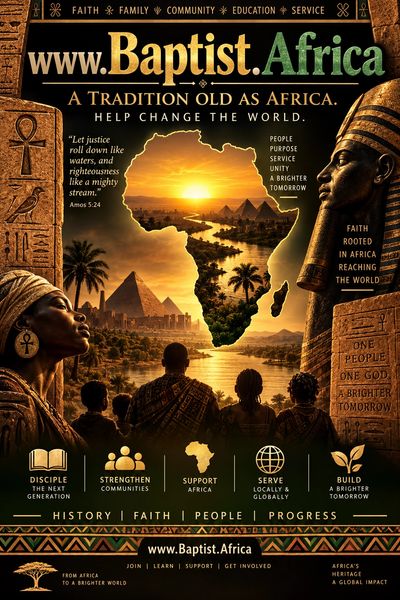
From Tebilath to Baptisma: A Historical and Lexical Genealogy of the Word "Baptist"
By William Worsley and AI Prompt Engineering Part of a Book Series Media in Presentation From "The Devil Don't Give a Damn" Copyright © 2022, 2026
Introduction
The designation "Baptist"—as both a grammatical agent noun (baptistēs) and a modern global denominational identity—possesses a rich, multi-millennial genealogy. Tracing the term requires a journey through Proto-Indo-European linguistic roots, ancient Near Eastern ritual washings (mikva’ot), the apocalyptic heraldry of John the Baptist in the Judean wilderness, the ecclesial fires of the Radical Reformation, and the powerful socio-spiritual flowering of the African Baptist tradition.
Rather than emerging in a vacuum in seventeenth-century Europe, the word carries a semantic weight shaped by centuries of liturgical evolution, anti-hierarchical theology, and liberation praxis. This study examines the linguistic, biblical, and historical developments that shaped "Baptist" from a descriptive function into a distinct religious heritage.
Philological and Etymological Origins
Root Derivations: From Baptein to Baptizein
At its core, the English word Baptist is derived via Latin (baptista) from the Ancient Greek masculine noun βαπτιστής (baptistēs—"one who immerses" or "the baptizer"). The nominal root rests upon the Greek verb family:
\text{Proto-Indo-European } (*g^w eh_2 b^h-) \longrightarrow \text{Proto-Hellenic } (*g^w apt\bar{o}) \longrightarrow \text{Greek } \beta\alpha\pi\tau\omega (\text{bapt\bar{o}}) \longrightarrow \beta\alpha\pi\tau\iota\zeta\omega (\text{baptiz\bar{o}})
Classical Greek distinguished carefully between bapten (\beta\alpha\pi\tau\epsilon\iota\nu), meaning "to dip" or "to dye/color" surface-level material, and baptizein (\beta\alpha\pi\tau\iota\zeta\epsilon\iota\nu), an intensive verb meaning "to plunge deeply," "to submerge," or "to overwhelm". In classical military texts (such as those by Polybius and Lucian), baptizein referred to a ship sinking beneath the waves or an individual overwhelmed by debt or drink.
In Classical usage, \beta\alpha\pi\tau\iota\zeta\epsilon\iota\nu carried a transformative quality. A vessel or object that was "baptized" in classical Greek literature did not merely touch the surface; it was wholly encompassed and saturated. This linguistic foundation established the physical modality—full immersion—that would later become central to those designated as "Baptists."
Ancient Near Eastern Foundations: Pre-Christian Water Rites
The Hebrew Mikveh and Levitical Purity
Long before baptistēs was applied as a personal epithet, ritual immersion was central to Near Eastern religious life. The Hebrew Bible set strict requirements for ceremonial cleansing through water (taharah).
Central to ancient Jewish practice was the Mikveh (מִקְוֶה)—a specially constructed pool filled with natural "living water" (springwater or rainwater). Immersion (tebilah) in a mikveh was required for:
- Restoration from ritual impurity (tum'ah).
- Priestly consecration (Exodus 30:17–21).
- Proselyte baptism (Giyur): Gentile converts to Judaism underwent self-immersion to signify the shedding of their pagan past.
┌────────────────────────────────────────────────────────â”
│ ANCIENT MIKVEH STRUCTURE │
├────────────────────────────────────────────────────────┤
│ [Steps Down (Unclean/Tamay)] ──► [Living Water Pool] │
│ │ │
│ [Steps Up (Clean/Tahor)] ◄─────────────┘ │
└────────────────────────────────────────────────────────┘
(Dual-staircase architecture preserved in ancient Jerusalem allowed pilgrims to descend impure on one side and emerge purified on the other).
Essene Asceticism and the Qumran Sect
By the second century BCE, the Essenes—an apocalyptic Jewish community at Qumran—elevated daily ritual washings beyond legal purity toward moral preparation for God's judgment. Their immersions combined physical cleansing with inward repentance, providing the immediate socio-theological environment out of which the first recognized "Baptist" would emerge.
Ioannes Ho Baptistēs: John the Forerunner
The First "Baptist"
The historic title "The Baptist" ([John] ho Baptistēs) makes its first appearance in history not as a denominational label, but as an exclusive functional title for John the Son of Zechariah (John the Baptist) in the Gospels and Josephus’ Antiquities of the Jews (Book XVIII).
┌──────────────────────────────â”
│ John the Baptist │
│ (Ἰωάννης ὠΒαπτιστής) │
└──────────────┬───────────────┘
│
┌────────────────────────┴────────────────────────â”
â–¼ â–¼
[Jewish Mikveh] [Apostolic Church]
Self-immersion for purity Sacramental/Covenantal rite
(Repeatable act) (Unrepeatable initiation)
John transformed traditional Jewish immersion (tebilah) in three radical ways:
- Initiator-Administered: Unlike the self-immersion of the mikveh, John actively immersed others in the Jordan River.
- Eschatological Repentance: It was a unique, non-repeatable act preparing individuals for the arrival of the Kingdom of Heaven.
- Universal Moral Necessity: Descent from Abraham was deemed insufficient; all required the baptism of repentance.
When Flavius Josephus writes of "John who was called the Baptist" (Ἰωάννης á½ á¼Ï€Î¹ÎºÎ±Î»Î¿Ïμενος Βαπτιστής), he marks a key historical transition. The action had defined the man; eventually, the theology behind the action would define an entire stream of the global Church.
Historical Evolution of the Denominational Title
From Anabaptist Scorn to English Reformation
For 1,500 years following the early Church, the word baptist remained tied to John or the act itself (baptisma). However, during the 16th-century Radical Reformation, opponents hurled the pejorative label "Anabaptist" ("Re-baptizer") at Christians who rejected infant baptism (paedobaptism) in favor of believer’s baptism (credobaptism).
In early 17th-century England and Amsterdam, separatist leaders John Smyth and Thomas Helwys formed the first English-speaking General Baptist congregation (1609). Soon after, Particular (Calvinistic) Baptists emerged in London (1638).
Radical Reformation (1520s)
└── "Anabaptist" (Pejorative term applied by critics)
│
├── English Separatism (Early 1600s)
│ ├── General Baptists (John Smyth / Thomas Helwys, 1609)
│ └── Particular Baptists (London, 1638)
│
└── Formalization of "Baptist" as a self-accepted designation
Initially calling themselves "Brethren of the Baptized Way" or "Baptized Churches," they eventually embraced the shortened title "Baptist" to denote their commitment to core convictions:
- Believer's Baptism by Immersion: Restricting baptism to confessing believers rather than infants.
- Soul Competency and Religious Liberty: Affirming direct accountability to God and rejecting state control over human conscience.
The African Baptist Tradition: Liberation and Sanctuary
The Crucible of the Black Church in America
The term "Baptist" acquired a profound resonance within the African diaspora. During the First and Second Great Awakenings in North America, Baptist theology—emphasizing direct access to God, egalitarian worship, and the symbolism of passing through waters of redemption—found fertile ground among enslaved and free Africans.
Historic Landmark
Year Founded
Key Figures
Significance
Silver Bluff Baptist Church
1773–1775
David George, George Liele
Recognized among the earliest Black Baptist assemblies (South Carolina).
First African Baptist Church
1773 (Constituted 1777)
Rev. George Liele, Rev. Andrew Bryan
Oldest continuous Black church body in North America (Savannah, GA).
National Baptist Convention, USA
1895
Elias Camp Morris
Consolidated Black Baptist autonomy, education, and civil rights leadership.
┌────────────────────────────────â”
│ 18th-Century Black Baptists │
└───────────────┬────────────────┘
│
┌────────────────────────┴────────────────────────â”
â–¼ â–¼
[First African Baptist, Savannah] [Global Missionary Expansion]
(Organized 1773 by Rev. George Liele) (George Liele to Jamaica, 1783)
Theology of the African Baptist Identity
In the African American experience, "Baptist" evolved into more than a liturgical preference; it became an instrument of spiritual and social liberation:
- The Jordan River Ideal: Immersion mirrored both Christ's death and resurrection and the physical escape across border rivers (such as the Ohio River) toward physical freedom.
- Ecclesial Autonomy: Local church independence allowed Black congregations to self-govern, educate, and organize free from outside control.
- Prophetic Leadership: The autonomous local church structure laid the foundation for leaders like Rev. Dr. Martin Luther King Jr., himself a lifelong Baptist minister whose rhetoric drew heavily upon the prophetic wilderness traditions of John the Baptist.
Conclusion
From its Proto-Indo-European etymological roots (gÊ·ehâ‚‚bÊ°-) to the Hebrew mikva'ot, the Greek Gospels, the European Reformation, and the historic African Baptist assemblies of Savannah and beyond, the word Baptist has undergone a multi-millennial transformation. What began as a descriptive verb for deep immersion developed into a unique personal title, a radical ecclesiastical movement, and ultimately a global heritage of faith, freedom, and conscience.