Muslim
ALLAH
The Spiritual and Historical Architecture of Islam: From the Divine Essence to the Global Ummah
To understand the worldview of Islam, one must trace its core terminology in a precise, logical sequence. This progression begins with Allah (the Divine Creator), centers geographically on Mecca, manifests through divine revelation in Al-Quran, defines the individual identity of the Muslim, structures devotion through Salah/Salat and Ramadan, and culminates in the global brotherhood of the Ummah.
1. The Divine Origin: Allah
In Islamic theology (Aqidah), everything begins with Allah (الله)—the proper Arabic name for the One, Unique, and Absolute God.
Allah (The One God)
│
Divine Revelation
│
â–¼
Al-Quran (Scripture)
│
┌────────────────┴────────────────â”
â–¼ â–¼
Individual Identity Sacred Geography
Muslim / Believer Mecca / Ka'bah
│ │
├─────────────────────────────────┘
â–¼
Devotional Practice
• Salah / Salat (Daily Prayer)
• Ramadan (Fasting)
│
â–¼
Global Community
Ummah (Faith Brotherhood)
Linguistically, the word Allah is a contraction of Al-Ilah ("The God"), signifying absolute monotheism (Tawhid). In Islamic scholarship, Allah is not a local deity, but the Eternal Creator of all existence, defined by total oneness:
"He is Allah, [Who is] One, Allah, the Eternal Refuge. He neither begets nor is born, nor is there to Him any equivalent." — Surah Al-Ikhlas (Quran 112:1–4)
Because Allah is the origin of all guidance, all Islamic principles, rites, and societal structures flow directly from His commands.
2. The Sacred Sanctuary: Mecca
In the geographical framework of Islam, Mecca (Makkah al-Mukarramah) holds an unrivaled position as the spiritual epicenter of the earth.
Long before the 7th century CE, Islamic tradition traces Mecca's sanctuary—the Ka'bah—to the patriarch Ibrahim (Abraham) and his son Isma'il (Ishmael), who built it as the first house dedicated solely to the worship of Allah.
- The Qibla: Mecca houses the Ka'bah, which serves as the Qibla—the unified direction of prayer for every believer across the globe.
- The Birthplace of Guidance: It was in the cave of Hira, on the outskirts of Mecca, that the prophet Muhammad received his first divine revelations.
3. The Divine Word: Al-Quran
The message sent by Allah to humanity was revealed to Prophet Muhammad through the Angel Gabriel (Jibril) over 23 years, compiled verbatim as Al-Quran (also written as L-Quran or the Quran, meaning "The Recitation").
In Islamic scholarship, Al-Quran is the primary source of law, ethics, theology, and spiritual guidance:
- Unchanged Record: Preserved in its original classical Arabic, the Quran provides the complete framework for human life.
- Living Recitation: Beyond written text, it is actively memorized by millions worldwide (Huffaz) and recited aloud during daily acts of worship.
4. The Believer: Muslim
A person who accepts the monotheistic truth of Allah and the authority of Al-Quran becomes a Muslim (literally "one who submits to God").
Being a Muslim is defined by both internal conviction (Iman) and outward action (Islam). The foundational declaration of faith—the Shahada—affirms: "There is no deity worthy of worship except Allah, and Muhammad is His messenger." Through this commitment, a Muslim aligns their individual purpose with divine will.
5. Daily Devotion: Salah / Salat
For the Muslim, the primary obligation connecting them back to Allah is Salah (often spelled Salat in formal transliteration), the ritual prayer performed five times daily.
- Direct Connection: Salah serves as an unmediated link between the creature and the Creator, establishing daily rhythm at dawn, noon, afternoon, sunset, and nightfall.
- Physical & Spiritual Unity: Worshippers stand shoulder-to-shoulder facing Mecca, reciting verses from Al-Quran and bowing (Ruku) and prostrating (Sujud) in complete humility before Allah.
6. The Annual Purification: Ramadan
While Salah anchors the Muslim's day, Ramadan—the ninth month of the Islamic lunar calendar—anchors the year.
- The Month of the Quran: Ramadan is revered as the month in which the first verses of Al-Quran were revealed to Prophet Muhammad.
- Fasting (Sawm): Healthy adult Muslims abstain from food, drink, and marital relations from dawn until sunset. Fasting fosters self-discipline (Taqwa), empathy for the needy, and spiritual gratitude.
- Community Spirit: Nights in Ramadan are marked by special congregational prayers (Tarawih) and communal meals (Iftar) that bring families and neighbors together.
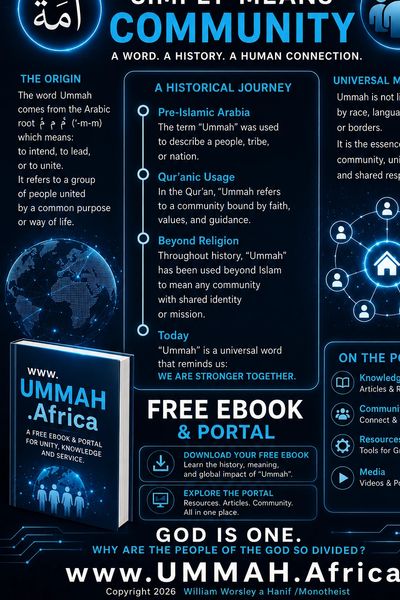
7. The Global Collective: Ummah
When individuals accept Allah, orient toward Mecca, recite Al-Quran, live as Muslims, pray Salah, and fast during Ramadan, they form a unified global body known as the Ummah.
Historical Evolution of the Term 'Ummah'
Pre-Islamic / Semitic Roots Islamic Transformation
(Root: ʾ-M-M / "Mother / Source") (Quranic Universal Covenant)
┌───────────────────────────────┠┌───────────────────────────────â”
│ • Clan, tribe, or geography │ ────────> │ • Universal faith brotherhood │
│ • Bound by bloodline/custom │ │ • Transcends race & borders │
└───────────────────────────────┘ └───────────────────────────────┘
The concept of the Ummah carries profound spiritual and social dimensions:
- Linguistic Origins: Derived from the Semitic root ʾ-M-M (sharing its lineage with umm, meaning "mother"), the term historically meant a group bound by law, place, or lineage.
- Quranic Elevation: In Islamic revelation, the word was transformed to signify a universal brotherhood of faith. The Quran defines the Ummah as a community called to moral excellence, social justice, and mutual support:"You are the best community produced [as an example] for mankind. You enjoin what is right and forbid what is wrong and believe in Allah." — Surah Ali 'Imran (Quran 3:110)
- Transcending Borders: Today, the Ummah comprises over 1.9 billion believers spanning every continent, ethnicity, and language—united by their shared worship of Allah, reverence for Al-Quran, and devotion to the sunnah of Prophet Muhammad.